

Showing posts with label veg garden. Show all posts
Showing posts with label veg garden. Show all posts
Monday, 20 April 2020
New Bits Of Growing Space
Every year I struggle to fit certain plants into my garden and struggle for space but this year seems worse already.

I guess I've gone a bit mad with my planting and I have certainly increased the numbers somewhat with each plant to try to sustain us more.

Tuesday, 2 April 2019
New Growing Areas Created
Well not completely new it must be said.
I'm going to show you all a picture of what was my soft fruit garden and you have to promise not to laugh!

ARGH! You promised!
This is my not so little corner of shame in my veg garden. It's a real shame because the veg garden, with it's 32 even beds and cordon apple trees down the side is looking pretty good these days, then as you get to the bottom you see this overgrown mess.
I'm going to show you all a picture of what was my soft fruit garden and you have to promise not to laugh!

ARGH! You promised!
This is my not so little corner of shame in my veg garden. It's a real shame because the veg garden, with it's 32 even beds and cordon apple trees down the side is looking pretty good these days, then as you get to the bottom you see this overgrown mess.
Tuesday, 14 August 2018
6 Gardening Tips for Hot Weather
This is a collaborative post.
This year has made me see some real short comings in my
garden lately, mainly in the fact that I’m not that well prepared for really
hot weather. With the soaring temperatures we’ve had lately it’s something that
we all need to give a bit of thought to.

Provide Some Shade
The greenhouse got up to some crazy temperatures on sunny
days. I noticed one day that it was well over 50 degrees C in there. I temporarily
shaded it by using an old dust sheet on the south side.
Having some gardening
supplies, like pots with water reservoirs would help as well. I think I
might even move back to having greenhouse beds rather than growing in buckets
in the future.
Wednesday, 14 June 2017
Keyhole Garden
As I'm completely and utterly obsessed with the subject of growing food I've read about many ways of growing food but it's sometimes good to see these in person.
I've never seen a keyhole garden in use before so I was pleased to see this one at Hellen's at the weekend.

Made from a wall that had fallen down nearby, with a wire mesh compost bin in the middle it really seemed to be doing it's thing. Planted with peas this year and courgettes the year before they say it performs well in the garden.
I love the idea of this. It wouldn't work in my intensive veg garden but the principle behind it is great.
Does anyone have a keyhole garden or would like one?
What are your experiences of them?
Wednesday, 24 May 2017
Friday, 7 April 2017
Season Extention
There's quite a bit of season extension going on in my garden at the moment!

I'm trying everything to see if I can get some earlier crops, I've got hoops with net (for birds really), hoops with plastic, hoops with fleece and black plastic to warm the soil, I've been transplanting crops that I started in modules in the greenhouse as well to give me the best possible start outside.
What do you do to get an earlier crop?
Thursday, 6 April 2017
Purple Sprouting
There's not huge amounts to choose from at this time of year in the garden.
I still have a few leeks left, lots of chard, nettles (hey their edible, they count!) and my love that is - purple sprouting.

Lets be honest, this is not an easy vegetable to grow. I've described it before as the "footballers wife" of the vegatble world.
It's high maintenance, a heavy feeder, in the plot a long time, every insect wants to eat it and every pigeon from miles around can see it and wants to land on it all winter.
And every year I think it's not worth the effort, until I eat some. Truth be told, I just love the stuff, my one daughter even eats it raw straight out the garden, I'll often find her snacking off the plant! And there is so little else at the moment that I'd be really lost without it.
So will I be growing it next year?
Yep!
And will it cause me so many problems that I think it's not worth it?
You can bet on it!
But come April next year I'm sure I'll feel the same as I do now!
Who else loves purple sprouting?
What veg do you grow that's loads of trouble and only worth it when you get to eat it?
Sunday, 2 April 2017
Row Cover Cloches
I've posted before about my chicken run row covers, my modular sized beds (10ft by 30") mean that I can make something for one bed and it will fit all of them.
The chickens have left the veg garden for the next few seasons and the chicken run turns into a row cover.
 |
| Full bed cloche |
I ordered some proper cloche cover off the internet and although it wasn't as cheap as builders plastic it should last a few years. Cutting it up to fit the cloches wasn't easy as it was pretty windy when I chose to do it. My three year old held the tape measure for me and we managed to cut them to size, it was amazing really, as without her help I wouldn't have been able to do it!


Currently all the covers are held on with spring clamps (like the type that market stall owners use), this means if I want to ventilate then I can lift the plastic up and hold it in place with a clamp.

I've got four cloches like this made up so I'm hoping it will extend my growing season for earlier and later crops as well as helping some that enjoy a little extra heat in the summer (tomatoes and peppers).
The one above has my early carrots (Paris Market) under it and I'll put one over my early potatoes, one over my beets and one over some salad.
I'm really looking forward to using these this year and seeing how they work out.
Anyone else make their own crop protection to extend the season?
Monday, 20 March 2017
Quinoa Growing - Small Scale Grain Growing
I'm very lucky to have a few friends who live quite near by and live a very similar lifestyle.
Last year when I was at one friends house I was very impressed with their beautiful quinoa growing in their back paddock, I asked them to take a few pictures so I could post it on the blog and she's written a great description of what they did below.

"We planted a 100 square foot bed with about 120 plants. The seeds germinated really easily in the greenhouse in a normal large plug tray. I planted them out when they were between 10-15cm high about a 10 to 12 inch spacing between each plant and row. They didn't need staking but did need protection from cheeky rabbits. Birds will not eat the Quinoa seed as it is coated in saponin so netting overhead isn't needed. I only watered them a couple of times to get established then maybe twice during growing season when weather was really hot for a prolonged period. They were very low maintenance plans. I mulched around the plants with grass cuttings to keep down the weeds. The colours on the Quinoa when it is flowering is stunning - we planted Rainbow Quinoa and had beautiful yellow, orange and red colours throughput the patch.

The seeds are ready once the flowers start to die back and colours go dull on the head of the plant. You can tell when the seeds are dry enough because they come out easily when you rub them between your fingers. We harvested ours on 10th September last year. They take around 90 days from planting to harvest. Once we had picked the flower heads we placed them onto a tarp and threshed them with garden canes. The kids absolutely loved this stage. Once we have a nice pile we passed it thought a garden riddle to get large pieces of leaf and stalk out. We then used a very simple system to winnow the grains using an electric fab to blow the chaff away from the seed, letting the clean seed drop into a bowl. We had to repeat this 2-3 times to get clean grain. We managed to get 2.5kg of grain from a small patch of very heavy clay soil.


I decided I would wash the quinoa before cooking rather than wash the whole harvest then attempt to dry it all out. The quinoa grain needs rinsing in water twice before cooking to get rid of the saponin. I was surprised how easy this was as the grain feels a bit sticky when you handle it. The result was a delicious quinoa that tasted fresher and nuttier than anything I have bought in a shop. A revelation on cooking the quinoa gave amazing results. Use twice as much stock as quinoa, and bring it to the boil then simmer until the quinoa has absorbed all the water (15-20 mins). Once the water is all absorbed, remove the pot from heat, cover it and let the quinoa steam for about 5 minutes."

Thank you Sarah!
I've long been interested in growing grains and trying to provide some of our staples from the garden, for the last few years I've said I was going to try Quinoa but haven't got round to it or haven't had the veg bed space ready.
I've read that it's one of the only grains worth growing on a small scale, especially as maize or corn doesn't grow that well here. From the look of their harvest it certainly looks like it would be worth some garden space in the future and she's given me with some seed to start my own if I want to.
What do you think?
Have you ever grown quinoa or another grain to eat?
How did you find it? Was it worth the effort? Is there another grain type crop that yields as well in a small space?
Sunday, 19 March 2017
An Organised Garden
Well almost!

The garden is probably at the only stage in the year where it looks remotely organised.
Beds are laid out, some of last years crops are still in the ground to be harvested and new ones are nearly ready to be planted.

As I've got quite a large number of beds laid out this year, I've decided to make sure they're numbered. That way I can easily keep records in my diary of what is planted where and I can also say to my wife that she can pick veg from ## bed if I'm not cooking that night.
I made the number tags from some off cuts of 6mm (1/4") ply, I painted the numbers on with some black oil based paint and then coated both sides of the tags with boiled linseed oil to give them a bit of protection from the weather.
I then went and tied these round the garden and realised that the planting plan I'd already drawn up (on the computer luckily) was the wrong way round so needed changing, that's why I've not shared it with you all yet!

The girls and I managed to plant some potatoes today as well, it's a nice first early variety called rocket which will be good with a salad, I know it's still early but I plan to use one of my hooped frames covered with plastic to make a mini polytunnel. Only one bed planted with them so far - bed 13 - unlucky for some!
Who else numbers their veg beds like this?
Anyone else got their spuds in yet?
Monday, 14 November 2016
View Of The Garden
Having the scaffold up on the house has given me a different view of the veg garden.
Here it is in all it's glory!

I've been steadily altering the beds down the right hand side to be narrower, 30" wide rather than 4ft wide. I'll alter the left hand side in the spring after I've had my winter crops out.
I'm also digging up my nursery bed at the end which contains around 100 young fruit trees or so to be put back into production as veg beds. I'm hoping to either plant or sell the fruit trees (mainly apple trees).
Hopefully down this main strip that should leave me with thirty 30" by 10ft beds, fifteenth either side, plus two larger beds at the top, by the greenhouse, to be herb, flower and experimental beds. This should be great for crop rotation and to mean we can grow more, as we've become a bigger family over the last few years we're suddenly eating a lot more, so the more I grow the less it costs!
All good in theory, I just hope I can keep on top of them. I have big plans to use plastic mulch, green manures, cover crops and inter-cropping to make sure I don't have too much space bare for weeds to take hold (again).
I also have plans for other areas to be used as growing areas, but I know I need to learn to not bite off more than I can chew all the time!
What do you think? Will I keep it under control?
Saturday, 28 March 2015
Horticulture Or Agriculture?
Farmer, gardener or forester?
With a small patch of land it's best not to pigeon hole yourself and you need to do a bit of everything to make it work, but it's easy to concentrate on one way more than another. There are many sub divisions to them all as well and they all blur together (agroforestry, permaculture, etc).
I always assumed that when I had a patch of land I'd be going down the traditional agriculture route, after all it's the way I brought up - on a mixed farm. I thought I'd get stock straight away, but I've concentrated on other things first, mainly the horticultural side of things.
This was driven home the other day when I had a friend walk round the homestead and she remarked on how much I had achieved in three years, whereas a phone call with my dad earlier that day he remarked that I hadn't done much with the land yet. Two different points of view but my father is very much of the traditional agricultural mindset, and my three fields have only really been cropped for hay so he has a point, the trees and the garden he sees as a sideline.
It's obvious when I think about it now, with a much smaller acreage than a farm any smallholding lends itself much better to horticulture than agriculture. Generally what I do is far more labour intensive and on a much smaller scale than what a farmer would do, but my returns can be much higher in food produced. I watched a video the other day where it said that an experienced gardener can produce five times the weight of vegetables than a farmer growing a cereal crop, I've no idea if this figure is correct or not but it sounds about right, even when I think about the weight of my squash harvest from two 4ftx10ft beds last year and compare that to the amount of wheat I would have got from the same space.

So today (Saturday) I'm continuing with my horticultural endeavours and I'm ploughing another patch of land to grow more vegetables and a small tree nursery (and maybe a small patch of grain as an experiment). I'm hoping to try to make this little patch earn it's keep by growing fruit trees I've grafted myself for sale and some more patches of beans and squashes that I might try to sell.
I am planning on getting stock this year, but, for me at least, horticulture is taking priority over agriculture at the moment.
Which way do you think you lean when it comes to what you do with your patch, no matter how big or small? Would you go in a completely different direction to me?
Tuesday, 16 December 2014
Raised Bed Materials
Next year I'm going to increase my growing area in the veg garden again. The bottom area is very wet and holds quite a bit of water. The plan is to install lots of cheap (free) raised beds using pallet collars stacked two high.

These worked brilliantly this year for growing my Jerusalem artichokes in, so the back fence will be lined with them giving me around ten 4ft x 3ft raised beds to house some of my more "unusual" crops and as a way of increasing a few of our staples like leeks.
When I picked this spot for the garden I didn't realise how wet it got down the bottom, it was the obvious place though and once I get round to putting a drain below it it should be much better, but until then it's raised beds for the last 30ft of veg garden (the rest is fine as it all slopes that way).
These pallet collars are no good for one of my winter projects though, as I have a crop planned that will out live them by several times over - Asparagus. I've been looking at all the types of raised beds I could build and I have my usual problem of wanting to have my cake and eat it to.
I want it to cost very little and I want it to last for ages! Is that too much to ask? It's going to be 20ft long by 4ft wide and about 18 inches high, so hopefully enough to give us a good spring feeding in a few years time.
 |
| My old garden raised beds made with half round rails |
 |
| Some rather brilliantly made compost bins at my friends fathers garden using railway sleepers and galvanised steels concreted in to hold them in place |
 |
| Friends fathers garden - Slabs used on edge to hold back soil |
 |
| Friends fathers garden - Blocks laid to form a large raised area to the garden |
At the moment I'm thinking of building the raised beds out of corrugated galvanised sheeting with a wooden top and frame to hold it in place. The frame will be easy to replace when it rots and the sheeting should last as long as the asparagus crops for.
What would you use for a long lasting raised bed?
Monday, 10 November 2014
6 Things I Wish I'd Thought About Before Upping The Scale Of My Garden
When I moved here I was already a reasonable vegetable gardener, but when I upped the scale from a garden and allotment to my large veg patch now, started from grass, there's a few tips that would have been handy:
1. Bare soil doesn't stay bare for long - I should have mulched, I should have mulched, I should have mulched! How many times have I thought this since planting my garden here. The weeds love a bit of bare soil. I would have been better off leaving some as grass and mowing it rather than giving the nettles a safe haven to grow in! Now it's a constant battle to try to keep them down
2. Don't let weeds go to seed - This applies to every garden but when you've got a large plot it soon gets out of hand. In fact it's not just normal weeds that become the problem, nasturtiums and marigolds were two of my chief weeds this year, pretty but not when they're in the wrong place! Also messy little corners of your plot soon creep out and before you know it you're knocking nettles down with a stick!
3. Just because you have the space to sow successionally doesn't mean you should - All the books tell you to sow every two weeks for certain crops like carrots. If you're anything like me you'll forget! It's better to sow lots in one go than to leave a patch, let the weeds grow and miss your chance for planting and although it's great to eat baby carrots, good sized ones are easier to prepare. Do whats best for you not what a book says.
4. Plant lots and lots of comfrey - Big gardens need big lots of nutrients, if you're growing organically then it can be tricky/labour intensive to find, begging farmers for muck is hardly fun. Planting a few large patches of comfrey means you can make your own liquid feed (along with nettle feed) and also you can mulch plants and fill trenches with it to grow hungry plants like beans. I brought no tomato food at all this year and grew 18 plants using just my home made comfrey and nettle feed with just as many tomatoes (if not more) than if I'd been buying a liquid feed. Keeping costs down when you've upped the scale is key but you still want everything to grow just as well.
 5. Divide it up - Dividing up my patch into beds was the single greatest thing I did to my plot. Now it's so much more manageable, I can easily crop rotate every year and plan where things are going to go. I can also weed a bed a night in the growing season, so it's not quite so soul destroying when I walk out and survey my mini jungle that seems to have grown overnight.
6. Pick you're battles - You can't win them all, so concentrate on certain things. This year I've been trying to keep the buttercups at bay, the annual weeds don't seem so bad compared to this hell sent plant. I've also been trying to make sure that no docks go to seed. These little battles should make the next year easier and then I can pick on another plant to pick on and try to hold back!
These are just a few that sprung to mind without much thinking involved. What other tips would you give for when you up the scale of your garden?
 |
| Nice garden with no weeds - not for long! |
1. Bare soil doesn't stay bare for long - I should have mulched, I should have mulched, I should have mulched! How many times have I thought this since planting my garden here. The weeds love a bit of bare soil. I would have been better off leaving some as grass and mowing it rather than giving the nettles a safe haven to grow in! Now it's a constant battle to try to keep them down
 |
| A weedy corner soon grows! |
3. Just because you have the space to sow successionally doesn't mean you should - All the books tell you to sow every two weeks for certain crops like carrots. If you're anything like me you'll forget! It's better to sow lots in one go than to leave a patch, let the weeds grow and miss your chance for planting and although it's great to eat baby carrots, good sized ones are easier to prepare. Do whats best for you not what a book says.
4. Plant lots and lots of comfrey - Big gardens need big lots of nutrients, if you're growing organically then it can be tricky/labour intensive to find, begging farmers for muck is hardly fun. Planting a few large patches of comfrey means you can make your own liquid feed (along with nettle feed) and also you can mulch plants and fill trenches with it to grow hungry plants like beans. I brought no tomato food at all this year and grew 18 plants using just my home made comfrey and nettle feed with just as many tomatoes (if not more) than if I'd been buying a liquid feed. Keeping costs down when you've upped the scale is key but you still want everything to grow just as well.
6. Pick you're battles - You can't win them all, so concentrate on certain things. This year I've been trying to keep the buttercups at bay, the annual weeds don't seem so bad compared to this hell sent plant. I've also been trying to make sure that no docks go to seed. These little battles should make the next year easier and then I can pick on another plant to pick on and try to hold back!
These are just a few that sprung to mind without much thinking involved. What other tips would you give for when you up the scale of your garden?
Wednesday, 29 October 2014
We Need Some Cold!
My brassicas are looking so good in the garden, I'm really proud of them this year.

But I looked a little closer and I could see that my hungry gap crop, purple sprouting broccoli, was doing a little too well!
It had started to produce the flower buds that we eat about 5 months early! I'm gutted really, although we'll still enjoy eating it, as it's a crop that is perfect for when there is little else about.
I put it in no early than any other year, but it's been such a good year for growing that it seems to have run away with itself! I could do with a good cold snap now to slow everything else down.
Anyone else had crops when they shouldn't this year?
Tuesday, 21 October 2014
This Years Squash Harvest
This years squash harvest has been particularly good and on Sunday Ev and me set about collecting them all up. I wasn't disappointed with the numbers!
 |
| A good number harvested! Should keep us going for a while! |
All of these squash were grown in two 4ft by 10ft beds (although they do spread everywhere) with sweetcorn growing between them. I put down plenty of manure before planting but I only watered them when I put the plants in, which I started from seed in the greenhouse and I never fed them all season.
I grew ones with smaller fruits this year as large ones have a habit of getting way too big, although some of these have gone the other way! One or two should make a good meal for our little family though.
 |
| These small ones have a really tough skin so they should keep well |
I've been talking to a number of bloggers lately about growing the staples we eat and the numbers we need to support us. I know I'm always going on about how wonderful squash are but I think we underestimate how important these veg were before the potato.
 |
| The bigger ones on another bench |
We've got a great supply now that should see us well into the hungry gap, although I need to find somewhere to store them all first.
How has everyone else done with squash this year?
Sunday, 7 September 2014
Preserving Sweetcorn - Drying
The Freezer is full. I long to have our large chest freezer back but we have nowhere dry with power to keep it, so I'm having to look at other methods of preserving any gluts we've got at the moment.
 |
| Trying with five corn on the cobs to start with |
The sweetcorn is tasting amazing at the moment, We all love the stuff but I planted far more than we need and I want to catch it while it's still sweet and not gone too starchy. Ideally freezing the whole cobs would probably be the tastiest way to preserve them, but like I said we've no space for that at the moment, so I decided to try drying them with our old polish food dryer.
 |
| Blanching them for 7-8 minutes to start with |
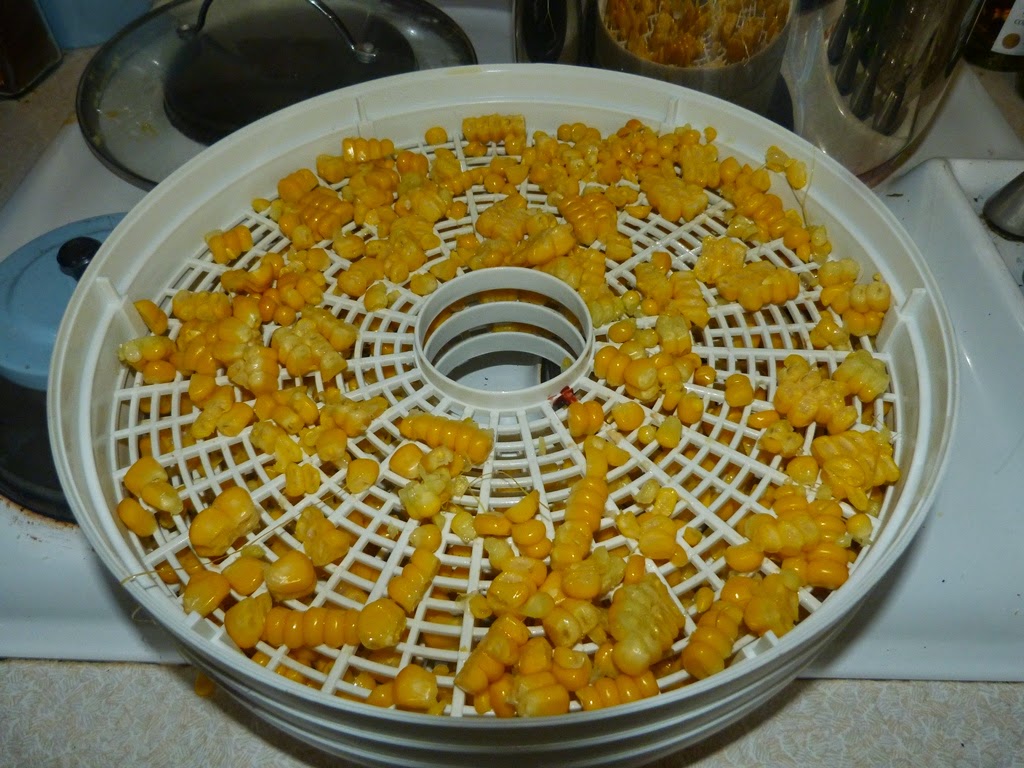 |
| All the corn is cut off the cob and spread out to dry on the trays |
 |
| 8 hours later the corns have all dried up |
 |
| Sealed in a kilner jar for when we next want them, they should keep along time like this |
The dried corns still taste super sweet when you have a chew on them, they should keep ages like this and five cobs worth takes up very little space. I'm not 100% sure what we'll use them for, I'm guessing we can rehydrate them and use them in stews and I did read that you can make really tasty fritters from them as well.
Hopefully next year I'm going to grow popcorn as well as I fancy having some home grown snacks, although they'll have to be some distance from my sweetcorn so they don't cross pollinate. Does anyone else grow much sweetcorn and popcorn and how do you preserve it?
Wednesday, 2 July 2014
Mulching With Wood Chip
I've managed to stay somewhere near on top of my veg garden this year with weeds, but the soft fruit garden is another matter. It's full of nettles and docks. And I mean full
 |
| There is a fruit garden here somewhere! Honest! |
So this week I've made it my job to tackle it before it all goes to seed. After a few people recommending a video I watched one over an hour long on the "back of Eden" system of gardening, I thought I'd try a lesser version of it and mulch the soft fruit garden with wood chip from my tree surgeon of a brother.
 |
| Laying newspaper down first once I've pulled the big weeds |
I laid a layer of newspaper or cardboard down first to try to suppress the weeds and then a good 4 inches or so of wood chip. I always thought that wood chip was meant to remove the nitrogen from the soil but apparently that's more when you dig it in, also you're meant to counteract it by adding manure to the surface when it's needed. Anyway I doubt it could use up more goodness that all the weeds!
 |
| Mulching the blueberries |
 |
| Blueberries mulched and netted |
 |
| I can now see what is fruit bushes instead of trying to find them in the weeds. |
I'm about a third of the way there with the fruit garden now. There is another couple of loads of wood chip at the farm that I'm going to bring up and lay down on the rest of it. I could also do with finding a source of cardboard as I'm thinking the same system would be good with my willow coppice to keep the grass down.
Anyone else been mulching with wood chip?
Wednesday, 11 June 2014
Nettle Sting
How do you know your nettle soft fruit garden has got too many weeds?

When your arm looks like this after half an hours weeding!
Think I need to wear a long sleeves shirt next time. I'm must be used to it though as it I could barely feel them stinging (hence why it happened so much) and just had a warm sensation in my arms afterwards.
Anyone else used to nettle stings?
Thursday, 5 June 2014
Chive Rust
A little gutted the other night as I discovered rust on my chives. This has come on suddenly and spread through the whole boarder of chives that surround my herb bed, the week of wet weather hasn't helped I guess.
 |
| Rust spread through the whole patch |
 |
| The chives are no more! |
I don't want it to spread to my garlic, onions, leeks and shallots so I pulled them all out and put them in my burning barrel. The chives are no more, it's a shame as they made a pretty boarder around the herbs and everyone said how nice they looked.
Anyone else have experience with rust on their chives or other alliums? Am I doomed to loose my onions as well due to them?
Subscribe to:
Posts (Atom)
